Adaptive lighting
Lighting designed to respond to local needs and environmental conditions.
CONNECTED INTELLIGENCE
TUIS Systems brings urban sensing, communication and essential services into a shared architecture — to protect people, infrastructure and the environment.
The film could not be loaded. Open directly
TERRA URBAN IMMUNE SYSTEM
TUIS Systems aims to create coordinated urban infrastructure. Sensing, interpreting information, communication and services are all parts of the same system.
Sentinel is one of its core urban units. The shared architecture is designed to turn local observations into a citywide understanding and coordinated operation. Compatible third-party technologies and partner services can complement TUIS developments.
TUIS is a development framework for a city's collaborative protection system. It considers everyday services and emergency preparedness together, to protect people, essential services and critical infrastructure.
The aim is to improve existing communities progressively: connecting individual units allows information and services from multiple locations to support coordinated operation.
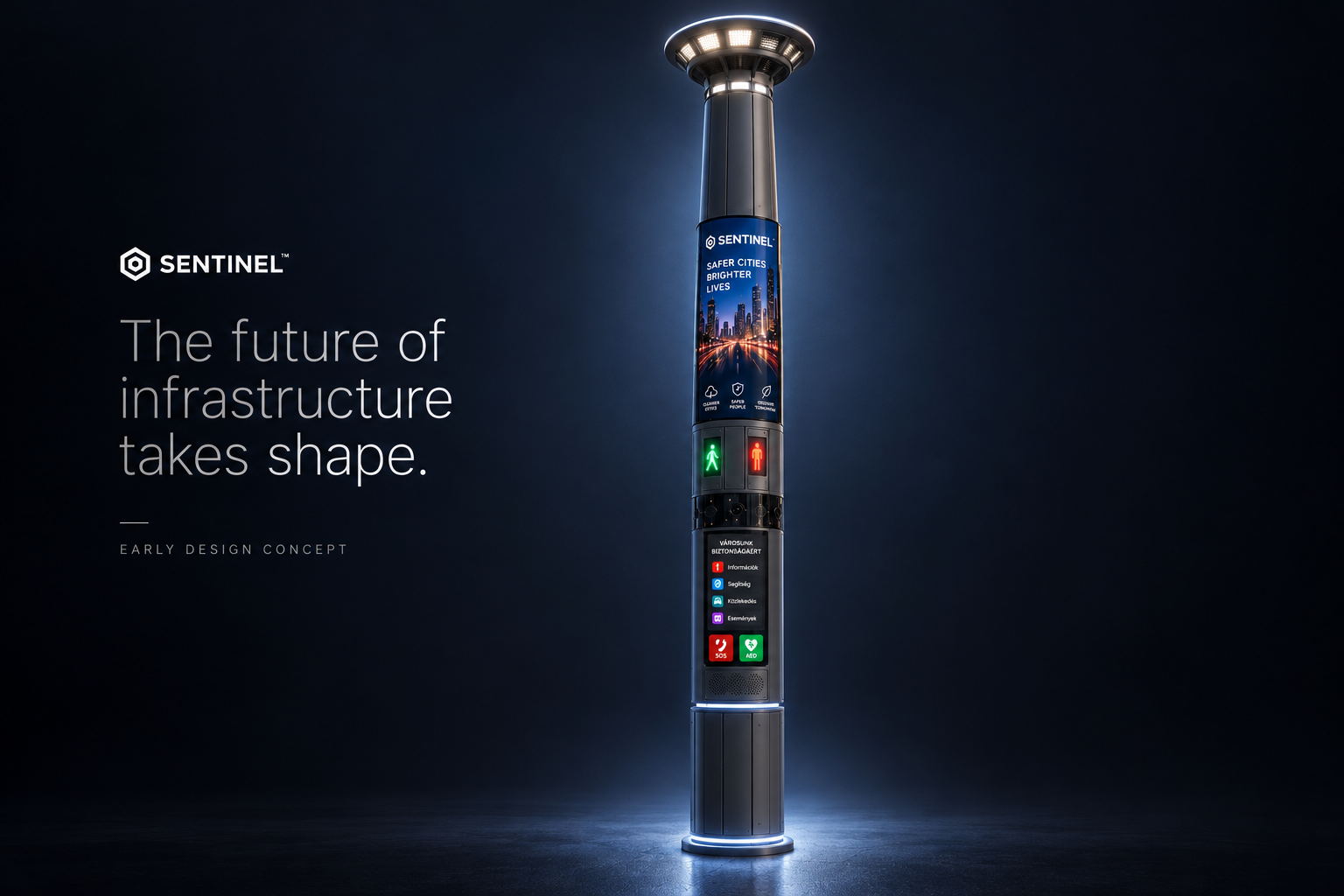 IMAGE SHOWS DEVELOPMENT PHASE 1
02 / SENTINEL
A modular infrastructure platform designed around local needs.
Sentinel is being developed to integrate lighting, public information, environmental sensing, communication and assistance functions. The design aims to expand services over time while retaining a shared physical platform.
Planned services ↓Planned functions can be adapted to each deployment. The final capabilities depend on the selected configuration and its validation.
Lighting designed to respond to local needs and environmental conditions.
The Media Belt's digital display can combine traffic, community and emergency information with commercial content. Advertising sales may provide a separate, potentially significant revenue stream within the operating model.
Potential integration of a local SOS function and an accessible AED, depending on configuration.
Integration of air quality, noise, temperature and other environmental measurements.
Shared infrastructure for communication and digital services suited to the location.
Modular development and serviceability, designed to retain the physical platform over the long term.
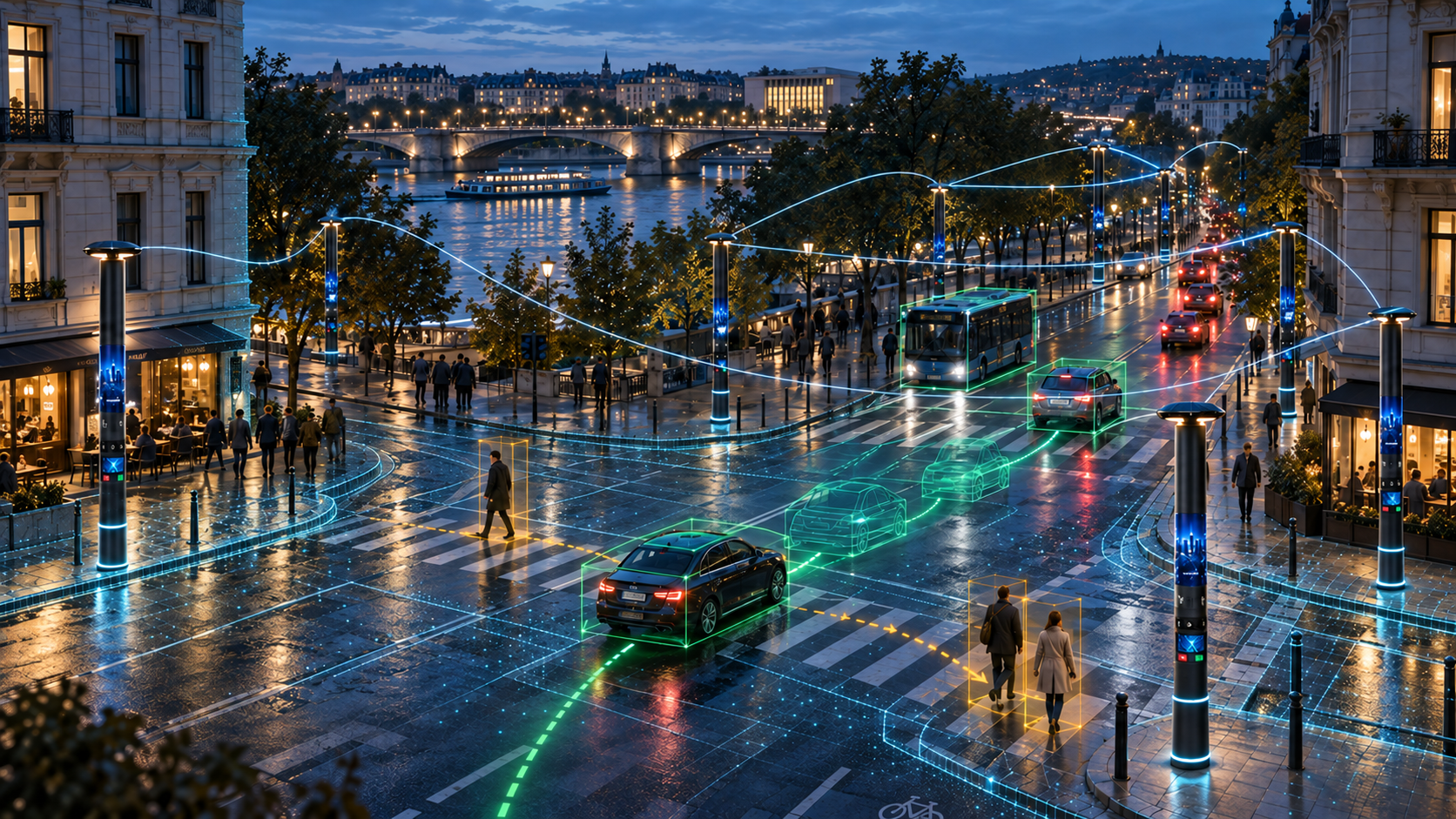
03 / ADDED VALUE AT SYSTEM LEVEL
One of the Sentinel system's development goals is to reduce the number and severity of road accidents, while supporting public safety and crime prevention.
We present the full range of Sentinel capabilities and services to prospective investors and customers in dedicated professional discussions.
This short demo introduces one application we can share publicly: supporting crime prevention. It illustrates how detection, vehicle tracking and a police alert can be connected.
The film illustrates the operating logic; it is not footage of the system in operation. Red lights are visual markers used to explain how sensing points work together. They do not represent Sentinel's actual light signals.
Sentinel development also includes proprietary systems concepts and operational solutions. These are intended to support cooperation between units, interpretation of events and continuity of operation.
Coordinated interpretation of vehicle and pedestrian movement is intended to identify traffic conflicts earlier. The goal is to reduce accidents and their severity.
In certain situations, the planned anticipation horizon is 5–10 seconds. The actual time gained depends on the situation and validated performance.
Potential applications include pedestrian crossings, junctions, main roads and motorways, with local warnings and data support for traffic systems.
THE PATH OF AN EVENT · ILLUSTRATION
A detected anomaly or request for assistance can be linked to a place and time. The event requires assessment: a signal alone is not evidence of a crime.
Collaborating sensing points may support earlier recognition of unusual events, interpretation of the situation and the alert process.
Location-based SOS and information for authorised agencies can support a response. Documented events may also assist later reconstruction.
The aim is to improve public safety and support prevention. Any impact on crime statistics must be established through real-world studies.
Details of proprietary solutions are available through dedicated professional and partner discussions.
EXTERNAL TECHNOLOGIES · SHARED SYSTEM
Adaptability to external technologies is one of Sentinel's core values: compatible solutions can work alongside TUIS developments within a shared infrastructure.
Sensors, communication solutions, applications or new services: the aim is to accommodate technologies from different developers. Integration is designed around each solution's technical, security and access requirements.
The Sentinel platform can be adapted to different locations, tasks and service needs. These application areas represent development directions.
The application concept covers urban public spaces, junctions, main roads and motorways, as well as bridges, transport facilities, campuses and industrial areas.
Lighting, information, environmental sensing, communication or assistance: the module configuration can be tailored to the purpose of the deployment.
The system is being designed to work with TUIS developments and compatible external solutions. Integration requires compliance with technical, security and access requirements.
The modular design aims to enable service expansion, component upgrades and new partner solutions while retaining the physical platform. Digital advertising may contribute to operation, depending on location, utilisation and commercial terms.
PROPRIETARY INTELLECTUAL PROPERTY
Developments at preparatory or differing stages of IP protection. Details of the systems concepts and operational solutions are presented in professional and partner discussions.
Alongside Sentinel, six further developments contribute to the TUIS Systems vision.
Modular urban infrastructure
↗Development area
·Development area
·Development area
·Development area
·Development area
·Development area
·05 / DEMONSTRATOR & VISION
The next step is a full-scale Sentinel demonstrator. Its purpose is to test the system's core assumptions and prepare for a real-world pilot.
Integrate the physical unit and selected core functions into a system that can be examined and tested.
Goal: a working demonstrator.
Assess performance and participant experience against predefined evaluation criteria.
Goal: measured results and lessons learned.
Use validated results to establish a framework for deployment, operation and strategic collaboration.
Goal: a repeatable deployment model.
Discussions with investors and partners focus on building the demonstrator, validation milestones and the conditions for future expansion.
06 / CONTACT
Investment enquiries and professional collaboration.